Thank you very much for taking the time to sign up for the No Blur! EyeMail Newsletter. The No Blur! EyeMail Newsletter is sent out approximately four times per year. The newsletter will contain the most recent developments in eyecare today, interesting information about your eyes, as well as a fun item. You can view the previous No Blur! EyeMails by clicking the online archive icon above. You can also send any comments or suggestions about the No Blur! EyeMail down in the related links section below.
The 2004 kickoff! I would like to take this opportunity after a rather long newsletter hiatus to welcome all
the new subscribers to the No Blur! EyeMail as well as thank all the former subscribers for still being there.
After much reprogramming of the website, the new format I believe is much cleaner and neater, more comprehensive,
and hopefully easier for you to find exactly for what you are looking. This newsletter has also received a facelift.
As seems appropriate to start this new format was my recent trip into the local broadcast news. Many people who
have had refractive surgery have been left with less than desirable outcomes. My work to restore functional vision
to these very irregular eyes caught the attention of WSVN. This along with Orthokeratology, was the "focus" of
the news broadcast. I hope that you enjoy the new EyeMail format and continue to find it useful. Please share
the newsletter with your family and friends. Sight is so important and my hopes with this newsletter is to keep
the public better informed about issues relating to this most precious gift that we call sight.
Dr. Maller
WSVN News Broadcast - Read the broadcast transcript and watch the broadcast through streaming video right here.
Recently it has been brought to my attention that the term "spherical aberration" is being discussed very heavily
in the general public yet the optical problems of spherical aberration are not accurately understood by these
people. That is not really a surprise since not many people in the general public have a theoretical optics
background. The reason it has become a relatively "hot topic" is because it is one of the complications after
refractive surgery, degrading the quality of the image and causing visual disturbances that are difficult to
function through. I will give a fairly accurate but hopefully easy to understand explanation of spherical
aberration here.
When light travels from one medium to another (such as water to air), the path of the light changes - it is "bent."
Anyone who has stood in a pool looking down at their own legs is familiar with this effect since their legs appear
to bend at the surface of the water. This bending of light is referred to as refraction. When light passes from
air through a curved surface such as a lens used in making glasses, the bending is more pronounced. The more curved
the surface, the more the light is bent. If the refracting surface is spherical (this would be like the surface
of a baseball), the light hits all parts of the surface and bends appropriately, but not equally.
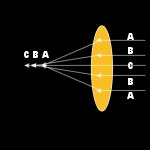
The light rays that enter along the "B" path bend less than the light rays along the "A" path. What this does is
it creates a "distortion" in the processed light since what had been a single point of light at the object turns
into multiple points when it is refracted into the image.
So, you might be asking yourself what does this have to do with eyes and why does this become a problem after
refractive surgery? First, spherical aberration only becomes a problem as more peripheral light is let into the
system. For example, if we placed a "filter" that blocked out all of the light along the "A" path, the image formed
after the refraction would be less distorted since those rays of light never even get through the spherical
surface. The eyes normally do something very similar to this filtration by using the pupil to limit the peripheral
light rays from entering the eye. Second, spherical aberration only becomes a problem at higher refracting powers.
For example, if our lens in the above example were of very low refracting power, the points "A", "B", and "C" would
almost be on top of each other but as the refracting power gets larger those points spread out causing more
distortion.
Our corneas in their pristine "virginal" state are not in fact spherical, but are aspheric. As you move along
the surface of the cornea from the center outward, the amount of curvature decreases very gradually. This
progressive flattening of the cornea from the center outward minimizes the optical problem of spherical
aberration because with this system the light traveling along path "A" focuses further back at point "C" and
not forward like in our example above. This is very important since the refracting power of the cornea is
enormous and as you remember, when the refracting power is large, spherical aberration becomes an important
factor. After refractive surgery is done on a cornea (i.e. LASIK) the aspherical shape is lost and so too is
lost the ability of the cornea to neutralize the spherical aberration. This is the reason that spherical
aberration increases after refractive surgery. The effect is even more problematic when the individual has
large pupils since that will allow all of the peripheral rays to enter the eye thus degrading the quality of the
image.
I know this is somewhat technical but I have tried to be accurate while also making it understandable. I hope
that I have succeeded!
There is a new glaucoma medication under FDA investigation from Alcon that is a combination of Travoprost and Timolol. The initial data from the trials show this to be a welcome addition to the medications available for treating Glaucoma. It appears to be safe, well tolerated by patients and lowers the pressure in the eye equivilently to the two drugs used together. We'll keep an eye out for the FDA final approval.
A recent study was released concerning Keratoconus and contact lens wear. Since contact lenses are the primary form of correction for this condition the study has considerable significance. The effect of contact lens wear particularly with contact lenses that do not transmit much oxygen through to the cornea, always brings up concern with the health of the corneal endothelium. This tissue is important in keeping the cornea functioning normally. Continued oxygen deprivation to the cells of the corneal endothelium cause their destruction. Since these cells do not grow back, there is certainly a concern if they die off and are not going to be replaced. The results of the study showed that gas permeable aspheric design lenses and soft toric lenses compared favorably but the Softperm (a hybrid soft and hard lens) causes considerable long term damage. Unfortunately, many Keratoconic patients are wearing this Softperm lens because no other lens could address their problems. Hopefully, with truly custom designed, topography guided contact lenses, these people can now be refit to healthier options.
A recent study looked at how Glaucoma patients are identified. The results of the study revealed that more than half of the participants had been diagnosed through routine examination and that no eye symptoms had been present. Of the patients who had eye symptoms bringing them into the the eye doctor's office, the majority had symptoms unrelated to Glaucoma. This underscores the importance of routine eye examinations to correctly diagnose and care for this blinding disease.
Sometimes while on the web, I will come across some item that is just fun. I have incorporated this into the website because everyone should have a little fun occasionally. I have decided to put at least one "fun" thing into each newsletter. I hope that you enjoy it. This particular item is a neat program that appears to be able to read your mind. You can find it at The Psychic
The EyeMail Newsletter from No Blur is a low volume, periodic emailing containing the most recent developments in eyecare today. It is provided as a free service by No Blur and is by subscription only. It is intended for anyone interested in current topics in eyecare. If you are receiving this newsletter in error, please unsubscribe above. To change your Email address, remove your name (unsubscribe above) and re-subscribe with your new address.
If you have any questions email us here at EyeMail Questions.
Read all of the other No Blur! EyeMails at the online archives.


 A Message From Dr. Maller
 Top
Top