Corneal Topography gathers an enormous amount of information about the surface of cornea. This provides insight to visual quality, vision problems, contact lens fitting, and even the health of the cornea.
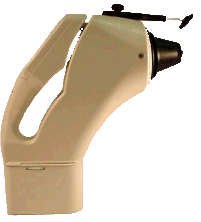
Corneal topography in short, is a detailed mapping of the corneal surface. The cornea is the clear dome that covers the colored part of the eye. For contact lens wearers, the cornea is the eye structure that is directly beneath the contact lens. The topographer begins the mapping process by using a painless, non-contact video capture technology. In simpler terms, a picture is taken of the surface of the eye. This picture is actually made up of a series of pinpoint "dots." Over 7,000 are measured and over 70,000 are analayzed. At each "dot" the topographer measures the curvature of the cornea. Each of these point measurements is then pieced together in concentric circles to represent the multitude of curvatures that describes the complex shape of the cornea. The topographer collects all of this data about the cornea in about the same time it takes to snap a family photo with your camera. Actually, for the patient, the topography is even easier than posing for a photo as there isn't even any flash used.
The topography photo measurements are repeated, usually three times per eye. The reason for this is to ensure good repeatable data collection. After all the photos are taken, the information is sent to the computer for analysis. The computer will take all the raw data collected from the topographer's thousands of point measurements, and process it so that it can now be represented in a form that is more intelligible and useful. The computer divides all the possible curvatures into a series of ranges. An analogy of this process would be for example if you were to measure the heights of a group of people. Let's say that there are fifty people in the group to be measured and their heights ranged from 5'0" to 6'2". To categorize the fifty people into manageable groups you could divide the heights into fifteen groups labelled 5'0", 5'1", 5'2", ..., 6'1", and 6'2" respectively. You then agree by convention that when measuring the individual to the nearest sixteenth of an inch, the individual will be put into the highest category that they have exceeded. For example, you measure the first person to be 5'6 3/16" tall. This person would be put into the 5'6" category. If the next person measures 5'9 15/16", they would be placed into the 5'9" category. You would do this for all fifty people until they were all properly sorted by height. Note that the person who is 6'0" will be in the same category as the person who is 6'0 15/16" tall even though the second person is almost an inch taller.
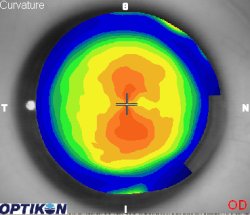
The computer takes the thousands of points measured and sorts them each into the appropriate curvature range. For visual aid, the computer defines each range by a specific color. All the collected data then is assigned the appropriate color, and a color map is generated and superimposed over the picture of the measured cornea. Many patients upon first seeing these color maps will say that they look like "weather maps."
The color map that the computer generates is very useful in obtaining an overall sense of the shape of the cornea that is being measured. In essence, this color map is actually the computer's representation of a three dimensional digital mold of the cornea. By using the topographer and the computer to process the data, the digital mold that is created is similar to the way a dentist would use impressions to create a physical mold of teeth.
By creating a digital mold of the cornea in this fashion, detailed analysis of the cornea is now possible. Conditions such as Keratoconus are easy to identify. Any unusual features readily stand out during this type of analysis. Contact lens induced problems can also be seen in this way. This detailed mapping is an invaluable tool to examine the surface structure of the cornea. Of course, when used in contact lens fitting, the topographer allows extremely complex contact lenses to be designed and manufactured to address the unique features of the individual's specific cornea. This type of contact lens, due to its very unique and specific nature, can significantly outperform an off-the-shelf type of contact lens. You can read more about this below in the related links section - Wave Technology and ZWave Technology.





 What Is Corneal Topography?
 Top
Top


